Now on the App Store and Google Play
See the patterns behind your child’s ADHD days
A 30-second daily check-in turns what you already notice into trends, weekly reports, and evidence-based strategies — so you can support your child with confidence, not guesswork.
New in the app
Meet Mabel, your co-pilot
Mabel is the elephant mum from our cartoon series, and now she lives in the app too. She walks you through your first few minutes, shares a tip each day, and cheers when you keep a check-in streak going.
- A short welcome tour, so you know exactly where to start
- A gentle evening reminder, in Mabel’s words, not a nag
- A little celebration at 3, 7, 14 and 30 days in a row

ParentPilot in 30 seconds
The real app, start to finish. No narration needed if you would rather read on.
What ParentPilot actually does
It is a tracker and a coach, not a diagnosis. Here is the whole idea in four parts.
It records what you already notice
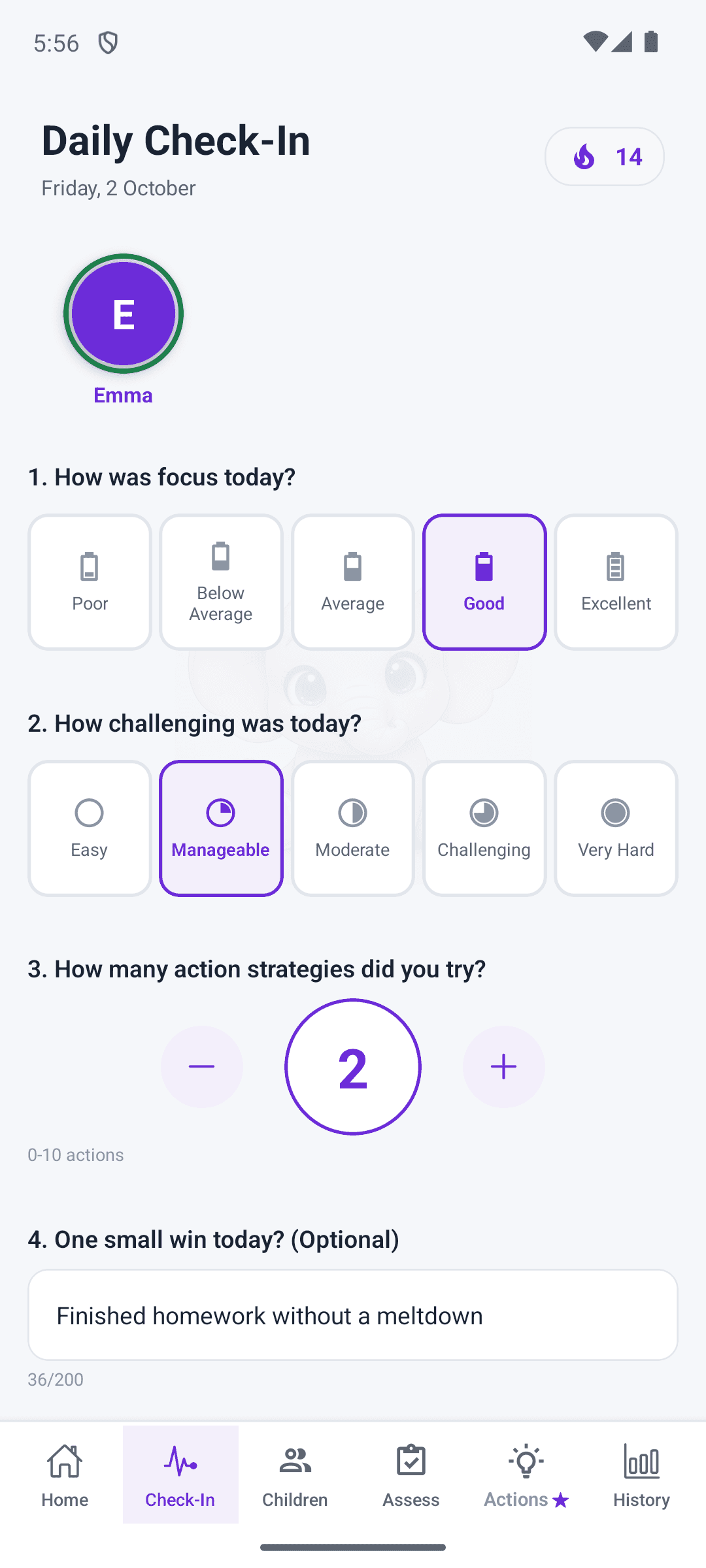
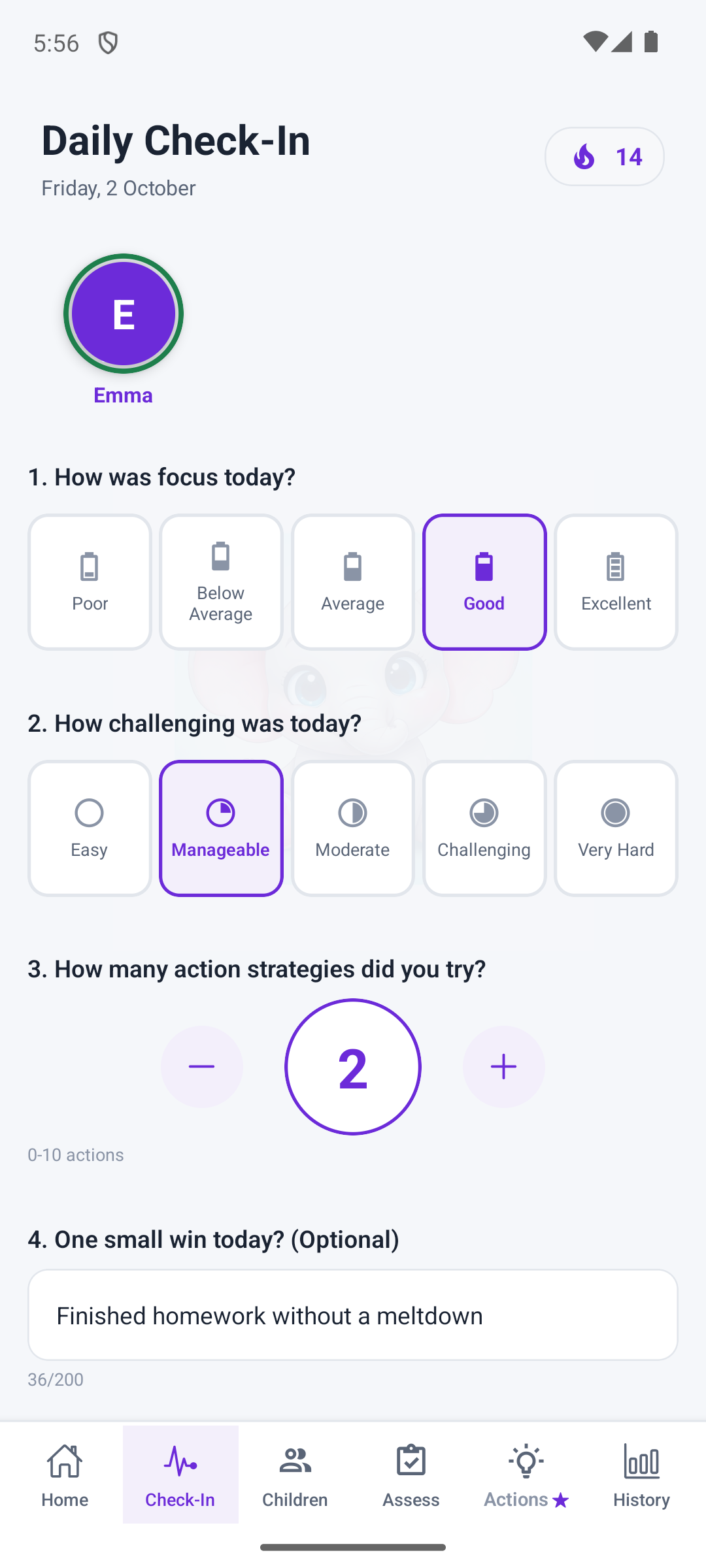
You rate focus, difficulty, how many strategies you tried, and one good moment. That is the whole daily check-in, and it is the only thing the app asks you to do regularly.
It turns those notes into a picture
Individually a day tells you nothing. Thirty of them show whether a new medication, term, routine or sleep pattern actually moved anything — and in which direction.
It suggests what to try next
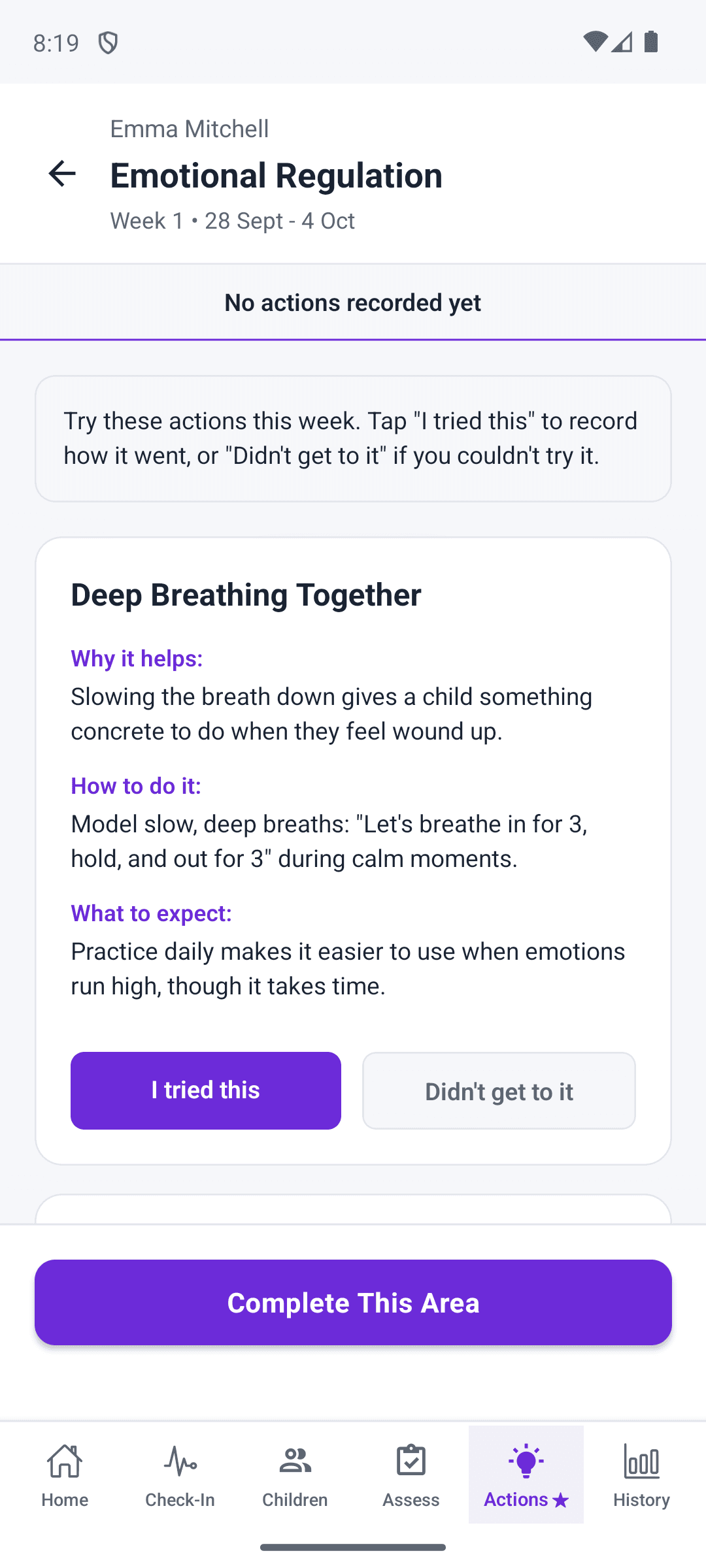
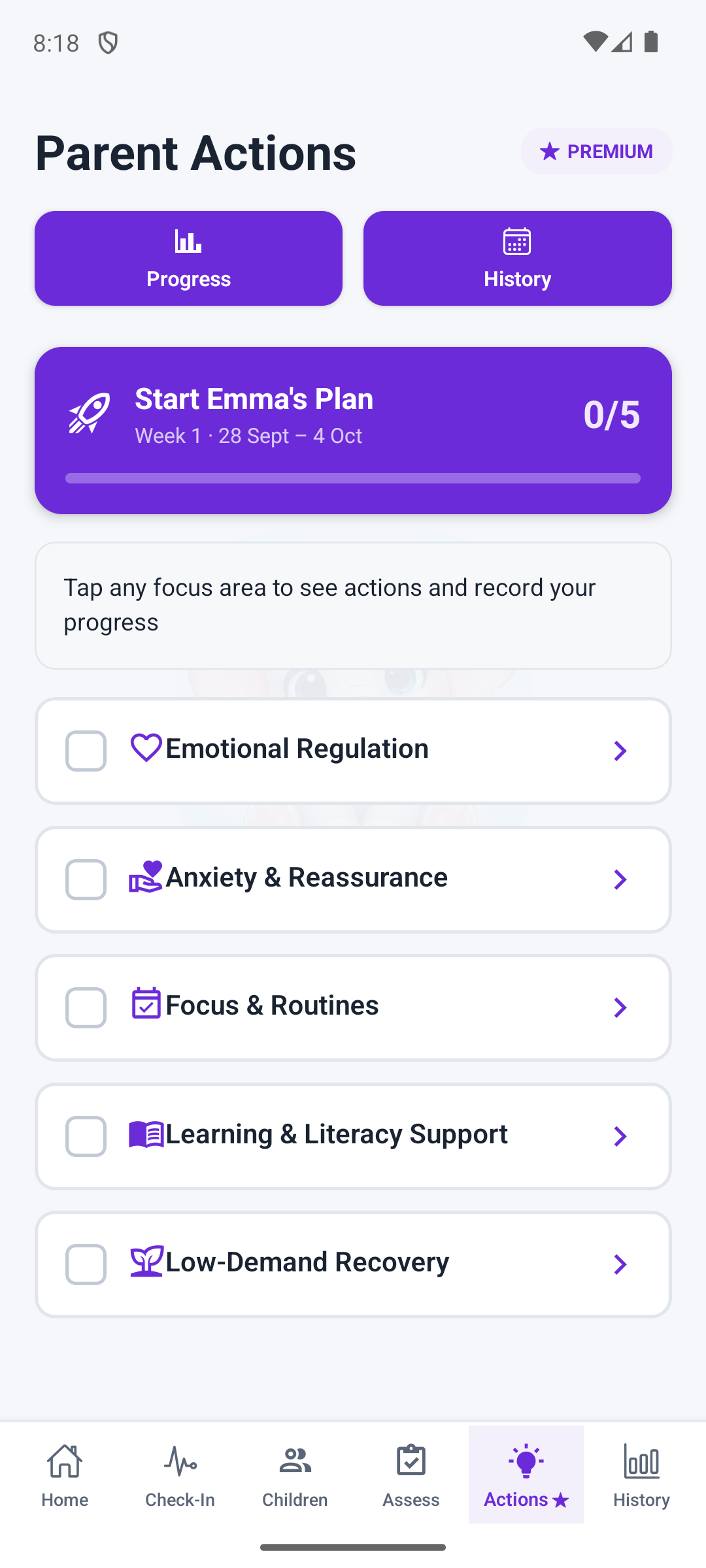
Each week the app picks 3–5 strategies matched to the areas your child is struggling with most, explains why each one helps, and asks afterwards whether it did.
It gives you something to hand a clinician
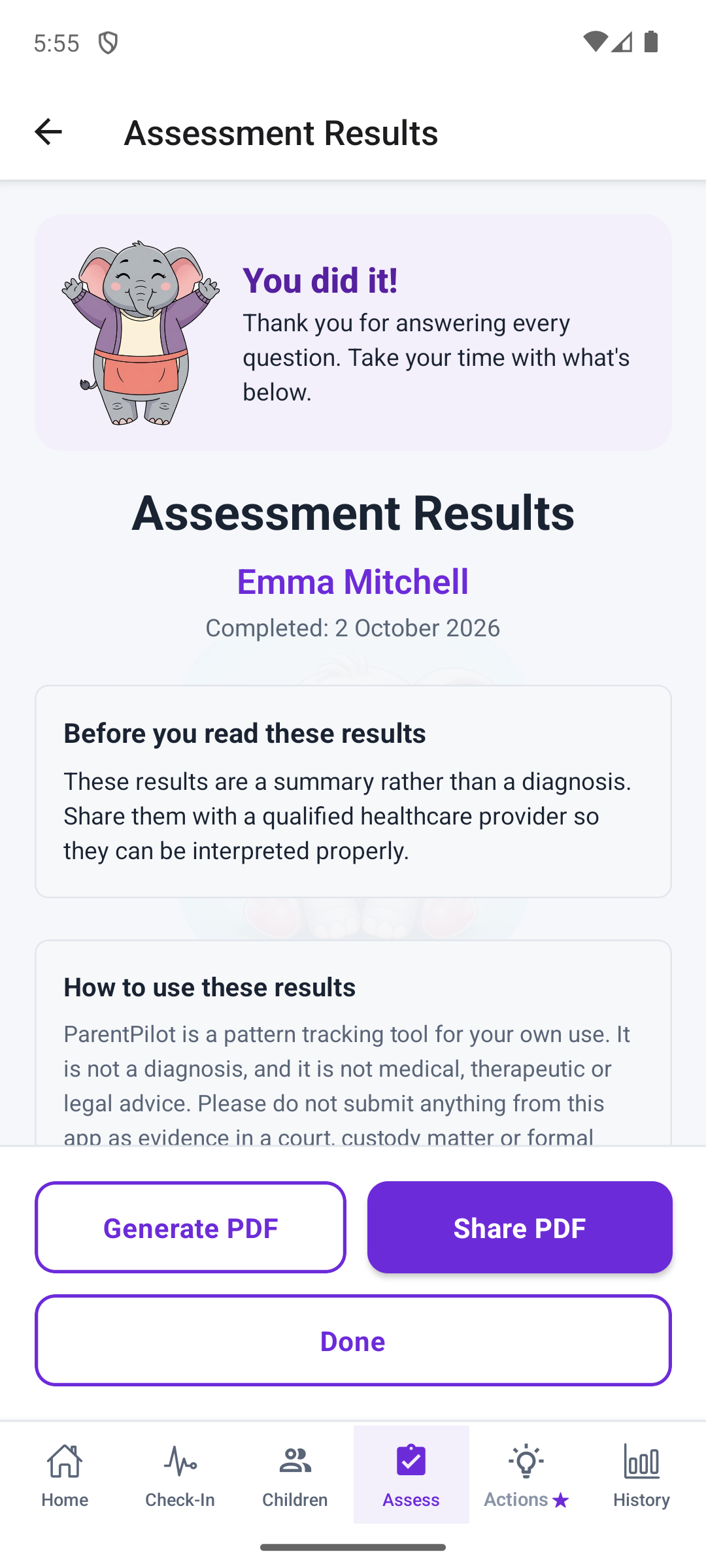
Appointments are short and memory is unreliable. ParentPilot exports a dated PDF of scores, trends and what you have already tried, so the conversation starts from evidence.
Premium · Weekly Insights
Your week, explained every Monday
Every week, your child’s check-ins are distilled into one clear report: what worked, what felt hard, and a professional analysis of the patterns underneath.
- What worked well, backed by your own data
- What felt challenging — without the guilt
- A look ahead with suggestions for next week
Mornings held for three days straight. Next week the checklist extends to the after-school routine.
Premium · Trend Analysis
Zoom out and see what’s actually working
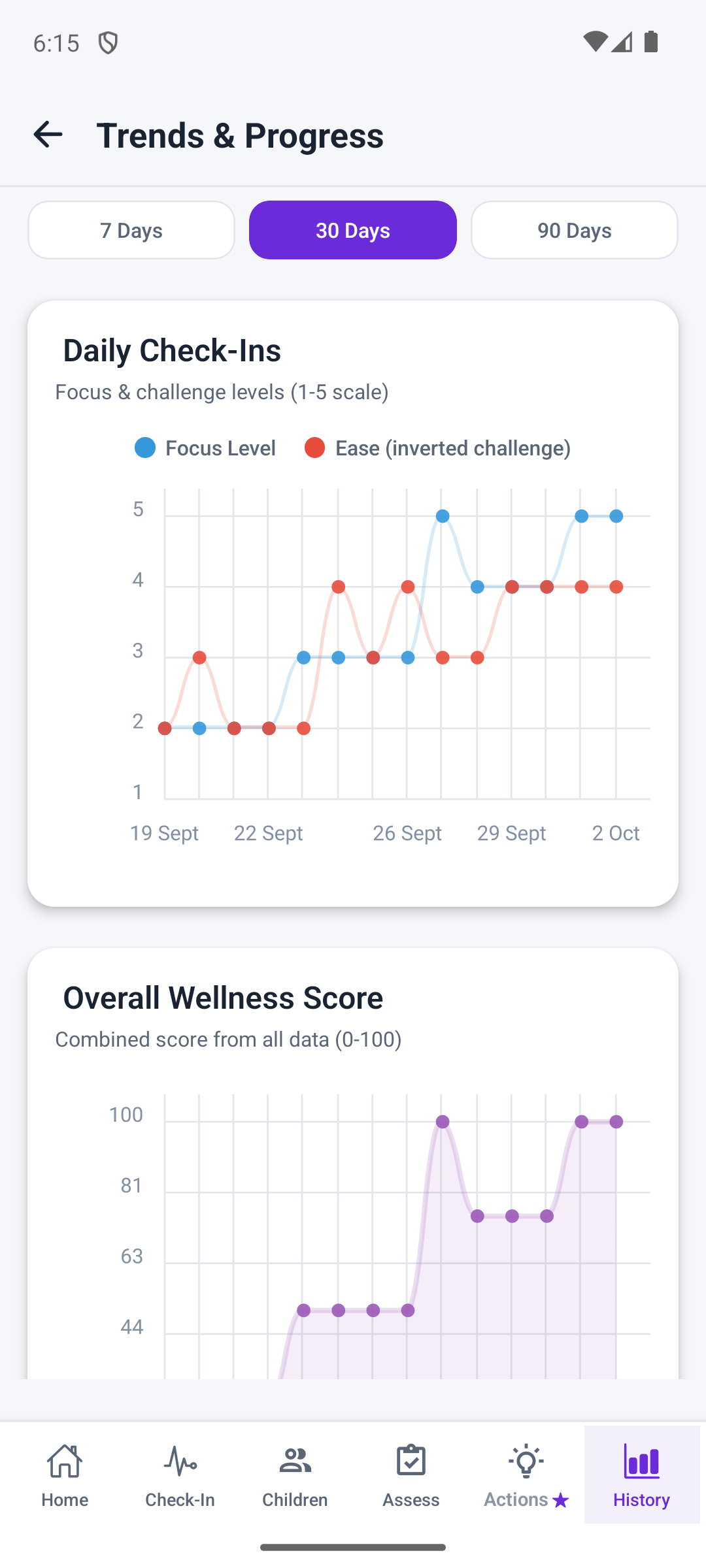
Daily life is noisy. Trends aren’t. Track focus, challenge levels, and an overall wellness score across weeks and months — and spot the long-term patterns hiding in plain sight.
- Focus & challenge levels over time
- Combined wellness score (0–100)
- 7-day, 30-day, and 90-day views
Premium · Comparison Mode
New medication? New routine? Measure the real impact
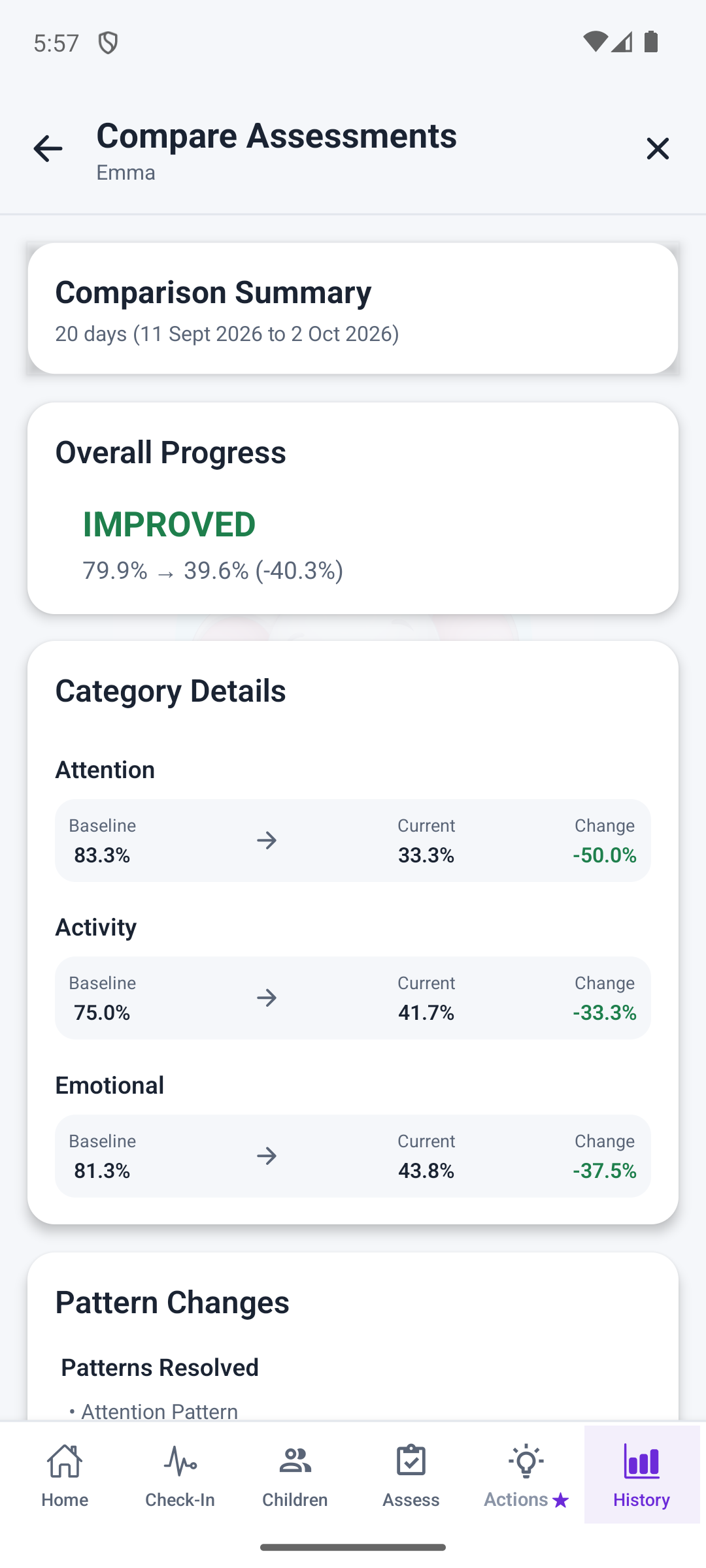
Compare any two time periods side by side. Instead of “I think it’s helping”, walk into your next appointment with the actual before-and-after.
- Compare assessments or date ranges
- Clear deltas across every metric
- Export as PDF for your clinician
Premium · Guided Parent Actions
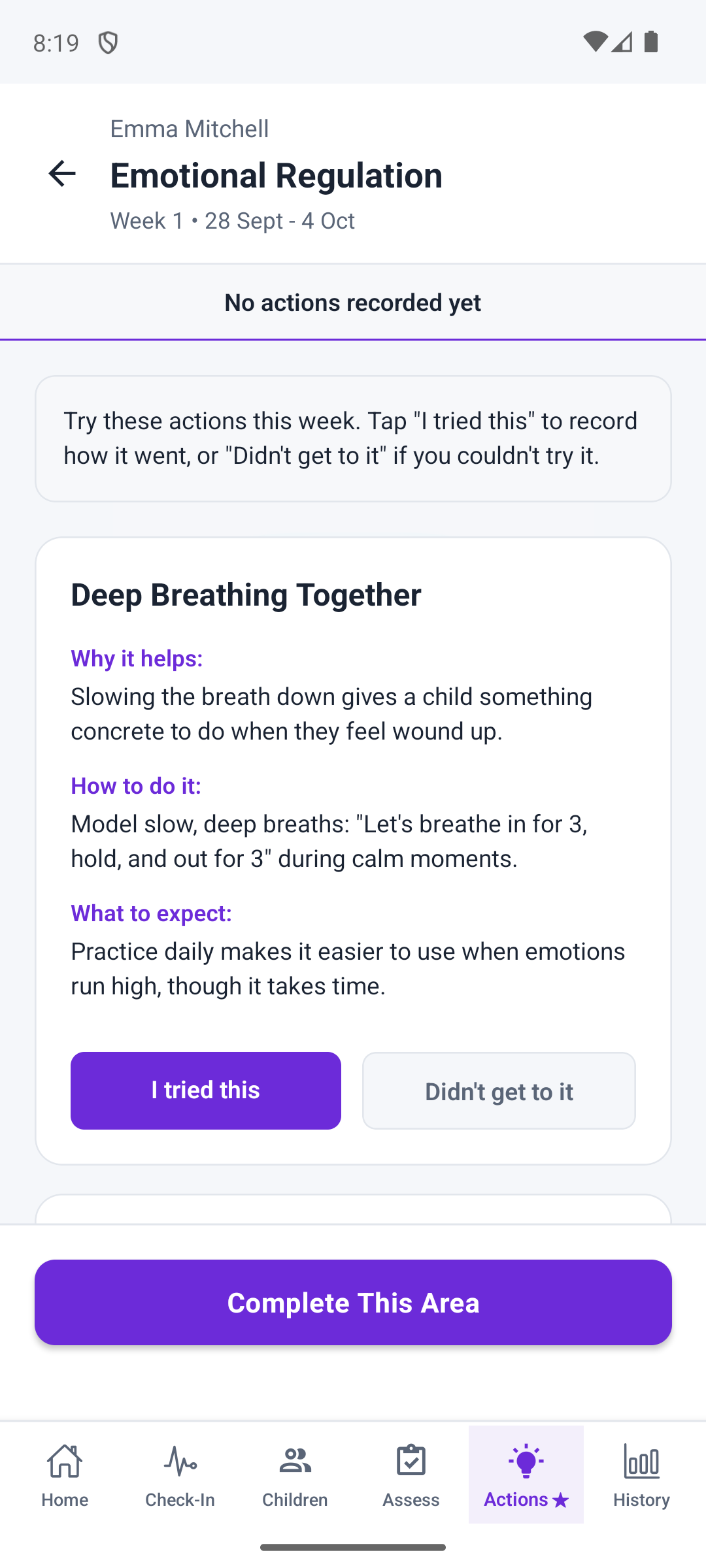
3–5 personalised strategies, every single week
Drawn from a library of 80 evidence-based techniques — CBT, DBT, ACT, Polyvagal Theory, Dr. Russell Barkley’s executive function model and Dr. Ross Greene’s Collaborative & Proactive Solutions — matched to your child’s specific challenges. Each focus area holds 16 strategies, and the app favours ones that have already worked for your child before introducing new ones.
- Emotional regulation & meltdown recovery
- Anxiety, focus, routines & literacy support
- Every action explains why it helps and what to expect
Straight from the app
No mock-ups here — this is what ParentPilot looks like today.
Started in minutes
From download to first insight, the whole setup takes less time than the school run.
Download & assess
Create your account, then run a free ADHD behavioural assessment inspired by the Vanderbilt Rating Scale.
Set up a profile
Add your child’s details, age, and any notes. Takes under two minutes.
Check in daily
Rate focus, behaviour, and mood each day. Thirty seconds, tops.
Act on insights
Get weekly reports and 3–5 personalised strategies for your child’s challenges.
Where the assessment and the plans come from
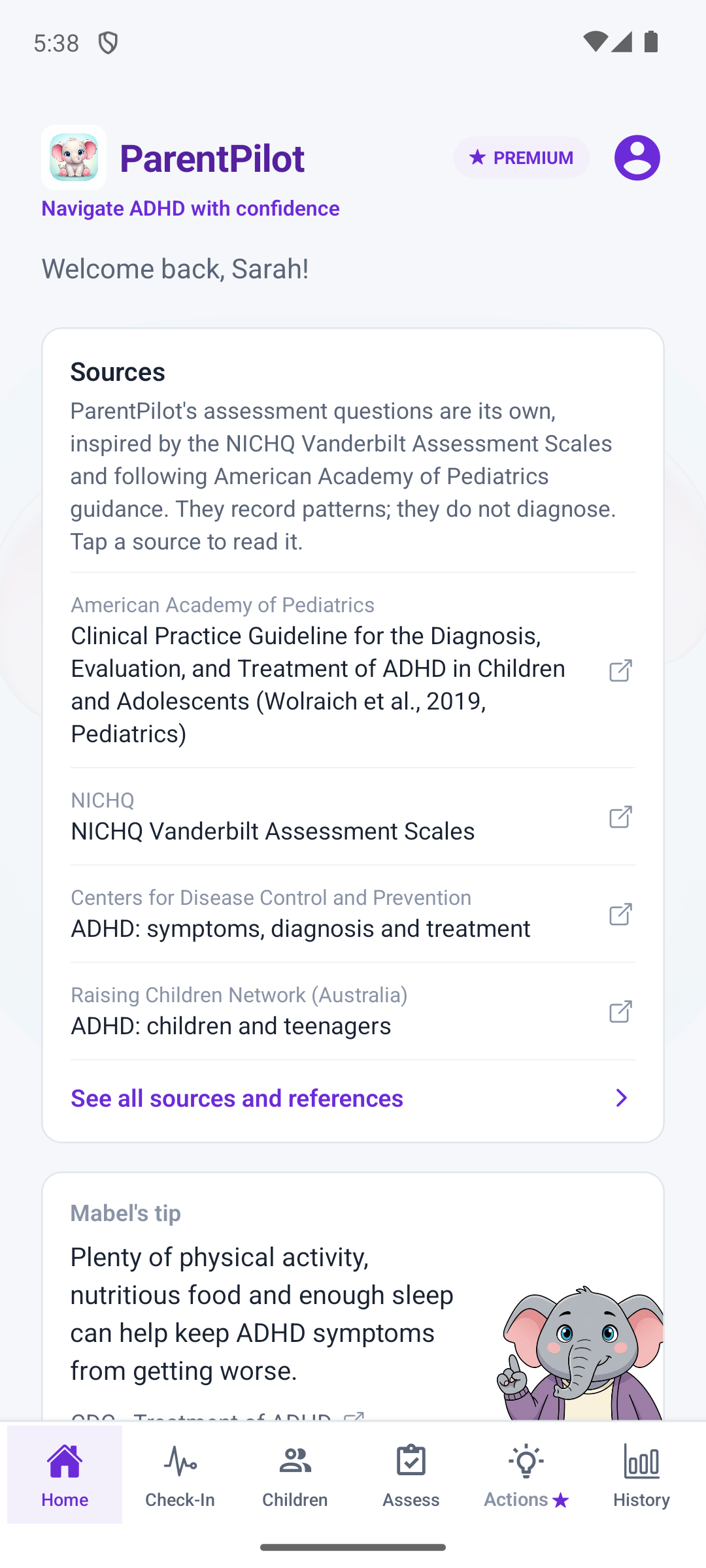
Every strategy in the app cites its source, and you can read that source inside the app.
The assessment
The questionnaire is inspired by the Vanderbilt ADHD Diagnostic Rating Scale, a behavioural rating scale widely used in paediatric practice. The questions are not the Vanderbilt instrument itself, and ParentPilot is a tracking tool, not a diagnostic one.
The weekly strategies
The 80 strategies sit in five focus areas and come from established therapeutic and ADHD-specific models. Each one names the approach it came from and what to expect.
Full reading list
- Barkley, R. A. & Benton, C. M. (2013). Defiant Children: A Clinician’s Manual for Assessment and Parent Training. Guilford Press.
- Greene, R. W. (2014). The Explosive Child. Harper.
- McNeil, C. B. & Hembree-Kigin, T. L. (2010). Parent–Child Interaction Therapy. Springer.
- Sanders, M. R. (2008). Triple P-Positive Parenting Program as a public health approach to strengthening parenting. Journal of Family Psychology.
- Zylowska, L., Ackerman, D. L., et al. (2008). Mindfulness meditation training in adults and adolescents with ADHD. Journal of Attention Disorders.
- Dawson, P. & Guare, R. (2009). Executive Skills in Children and Adolescents. Guilford Press.
- Abikoff, H. & Gallagher, R. (2013). Organizational Skills Training for Children with ADHD. Guilford Press.
- Rapee, R. M., Wignall, A., Spence, S. H., Cobham, V. & Lyneham, H. (2000). Helping Your Anxious Child. New Harbinger.
- Shaywitz, S. (2003). Overcoming Dyslexia. Knopf.
- Gross, J. J. (2014). Emotion regulation: Conceptual and empirical foundations. Handbook of Emotion Regulation.
- Lucyshyn, J. M., Dunlap, G. & Albin, R. W. (2002). Families and Positive Behavior Support. Paul H. Brookes Publishing.
Practical guides for parents
Written for the parts of this that nobody explains. Morning routines, restraint collapse, and how to make medical appointments count.
How to Get a Child with ADHD Through the Morning Routine
Why mornings go wrong so reliably, and five changes that reduce the number of reminders you have to give.
Why Your Child Falls Apart After School, and What Helps
Why the child who is fine for teachers comes home and explodes, and how to change the shape of the afternoon so it happens less.
What to Bring to Your Child's ADHD Assessment
The records clinicians actually ask for, how to describe behaviour so it can be used, and what to gather in the weeks before the appointment.
How to Talk to Your GP About Your Child's Behaviour
How to prepare for a short appointment so you leave with a referral or a clear next step, rather than general reassurance.
Your family’s data stays yours
Never sold, never shared with third parties. Delete everything any time, straight from the app.
Start free. Stay if it helps.
The assessment and daily tracking are free forever. Premium unlocks the insights.
Always included
- ADHD behavioural assessment
- Child profiles (up to 4)
- Daily check-in tracking
- Assessment history
Ads shown when downloading assessment PDF
Just $2 a month
- Everything in Free
- Weekly Insights reports
- Trend Analysis charts
- Compare assessments
- Guided Parent Actions
- No ads
No commitment, cancel anytime
- Everything in Free
- Weekly Insights reports
- Trend Analysis charts
- Compare assessments
- Guided Parent Actions
- No ads
Frequently asked questions
Everything you need to know about the assessment, daily tracking, and clinician reports.
Does ParentPilot diagnose ADHD or replace medical advice?
No. ParentPilot is a tracking tool for parents, not a diagnostic instrument or a medical service. Only a qualified health professional, such as a paediatrician, child and adolescent psychiatrist or psychologist, can diagnose ADHD, and a proper assessment involves a developmental history, direct observation and evidence from more than one setting. What ParentPilot does is turn what you notice at home into a dated record, so the appointment starts from specifics rather than recollection.
How does the Vanderbilt-inspired behavioural assessment work?
It is a 48-question questionnaire of original questions, inspired by the Vanderbilt ADHD Diagnostic Rating Scale but not the instrument itself. It covers attention, activity level, emotional regulation and how daily life is affected at home. You can repeat it as often as you like, and every result is kept in your history. The questionnaire has not been through clinical validation studies.
Can I export reports for our paediatrician or GP?
Yes. Any assessment can be exported as a dated PDF showing the scores in each area alongside your check-in history, so you have something concrete to hand to your GP or paediatrician instead of trying to remember it in the appointment.
How much time does the daily check-in take?
About 30 seconds. You rate your child's focus, note how challenging the day felt, record which strategies were tried, and celebrate one win. It is intentionally designed to be lightweight so parents can sustain it for weeks and months.
Can I track more than one child?
Yes. You can add distinct profiles for each child with their own assessment history, check-in streaks, photos, and milestone logs.
What is included in Free vs. Premium?
The 48-question assessment, daily check-ins, PDF report exports, child profiles and your full history are free. Premium adds the weekly action plans drawn from 80 researched strategies, weekly insights, trend analysis and assessment comparison. Premium is $2.99 a month, or $23.99 a year, which works out at $2 a month. Both plans start with a 7-day free trial.
How is our family's private health data protected?
Your child's information is treated as sensitive health data. It is stored securely, it is never sold, and it is not shared with anyone without your consent. You can permanently delete everything from Settings at any time.
ParentPilot helps you observe and record your child’s behaviour over time. It is not a diagnostic instrument, and nothing in the app should be taken as medical advice. If you have concerns about your child’s attention, behaviour or development, please raise them with your GP, paediatrician or another qualified health professional.

Know your child. Really know them.
Free ADHD assessment included. Premium from $2/month on the yearly plan.
Download ParentPilot today.
