You have waited months for this appointment. You sit down, the paediatrician asks how often your son has trouble finishing something he has started, and your mind goes completely blank. You know it happens constantly. You could not tell them whether it is three times a week or fifteen, or whether it is worse than it was last year, and you certainly cannot tell them what the teacher has been seeing.
This happens to almost every parent, and it is not a failure of memory. Nobody can summarise eight months of family life on the spot under pressure. But it does cost you, because an ADHD assessment is built almost entirely out of the information you bring to it. The clinician is not testing your child in the way a school test works. They are constructing a picture from developmental history, from direct observation, and from evidence about how your child functions in more than one setting. Most of that has to come from you.
This guide covers what to bring, how to write it down so a clinician can actually use it, and the few things that are worth avoiding.
Why what you bring matters so much
A diagnosis of ADHD requires evidence that difficulties show up across settings and have been present over time, not just in one classroom or one difficult term. The clinician cannot observe your child at home, at school, at a birthday party and at bedtime. They have one appointment, in a quiet room, with a child who knows something important is happening and is often on unusually good behaviour for the duration.
So the appointment is only as good as the evidence in front of it. Parents who arrive with dates, frequencies and school reports usually get much further in one visit than parents who arrive with a general sense that things are hard. That is not a difference in how much they care. It is a difference in how much the clinician has to work with.
What to bring to the appointment
Gather as much of this as you reasonably can. You will not have all of it, and that is fine. Bring what you have.
- School reports and teacher comments. This is the single most valuable thing after your own records. Written comments matter more than grades. If the teacher has emailed you about concentration, organisation or getting started on tasks, print those emails. Evidence from outside the home is central to the assessment, because a pattern that appears only in one setting points somewhere different from one that appears everywhere.
- Any previous reports. Speech pathology, occupational therapy, psychology, and importantly hearing and vision testing. If your child has not had a hearing and vision check recently, book one before the appointment. Difficulties that look like inattention sometimes turn out to be a child who cannot reliably hear the instruction or see the board.
- A developmental history. Pregnancy and birth, when your child walked and talked, any early concerns raised by a nurse or preschool, and whether anyone else in the family has been assessed for ADHD, a learning difficulty or a mental health condition. Family history carries real weight and is often the thing parents forget to mention.
- Sleep information. What time your child goes to bed, how long they take to fall asleep, whether they wake in the night, and what mornings look like. Sleep problems both imitate and worsen attention difficulties, so this comes up in almost every assessment.
- What you have already tried. Reward charts, visual timetables, changes to routines, adjustments at school, removing screens. Note what happened with each, including the things that made no difference. This shows the difficulty has persisted through reasonable attempts to address it, and it saves the appointment being spent on suggestions you worked through two years ago.
- Current medications and supplements, including anything for asthma, allergies or sleep.
- Your questions, written down. You will forget them otherwise. Everybody does.
How to describe behaviour so a clinician can use it
This is where most preparation goes wrong. Parents arrive with adjectives when clinicians need counts. "He is always distracted" is a true statement that gives a paediatrician almost nothing to work with. "Homework takes about ninety minutes for twenty minutes of actual work, five nights a week, and it has been that way since the start of the year" can be used immediately.
Every observation you bring should try to answer three questions: how often, how long, and where. Frequency, duration and setting. Once you have those three, an impression becomes evidence.
Compare these pairs and the difference becomes obvious straight away:
- "She never listens" becomes "she needs an instruction repeated four or five times before she starts, most mornings, and it is worse when the television is on."
- "He is disorganised" becomes "he has lost three jumpers and two lunch boxes this term, and he forgets his homework diary about twice a week."
- "She melts down over nothing" becomes "she has an outburst lasting twenty minutes or more roughly four afternoons a week, almost always between school pickup and dinner."
She never listens
She needs an instruction repeated four or five times before she starts, most mornings, worse with the television on
He is disorganised
Three jumpers and two lunch boxes lost this term, forgets his homework diary about twice a week
She melts down over nothing
An outburst lasting twenty minutes or more roughly four afternoons a week, almost always between pickup and dinner
Every observation should answer three things: how often, how long, and where.
The second version in each pair took no more effort to live through. It only took writing down at the time rather than reconstructing later.
Start recording before the appointment, not the night before
Human memory has a specific bias that works against you here. It over-weights the last few days and the most dramatic incidents. If you sit down the evening before the appointment and try to summarise the last six months, what you will actually produce is a fairly accurate account of a bad fortnight.
A short daily note fixes this, and it does not need to be elaborate:
- Pick a time you will actually do it. Most parents find just after the children are in bed works, because the day is finished and you still remember it.
- Rate the day on two simple scales: how focus was, and how challenging the day was overall. One to five is enough. You are not measuring anything precisely, you are creating something comparable across days.
- Write one or two specific things that happened, with numbers where you can. Not a summary, an example.
- Note anything you tried and whether it seemed to help.
- Write down one thing that went well. This keeps the record honest, and it is the main reason people keep going.
Three or four weeks of this is worth more than any amount of preparation on the day. If your appointment is months away, which it often is, you will walk in with something genuinely substantial.
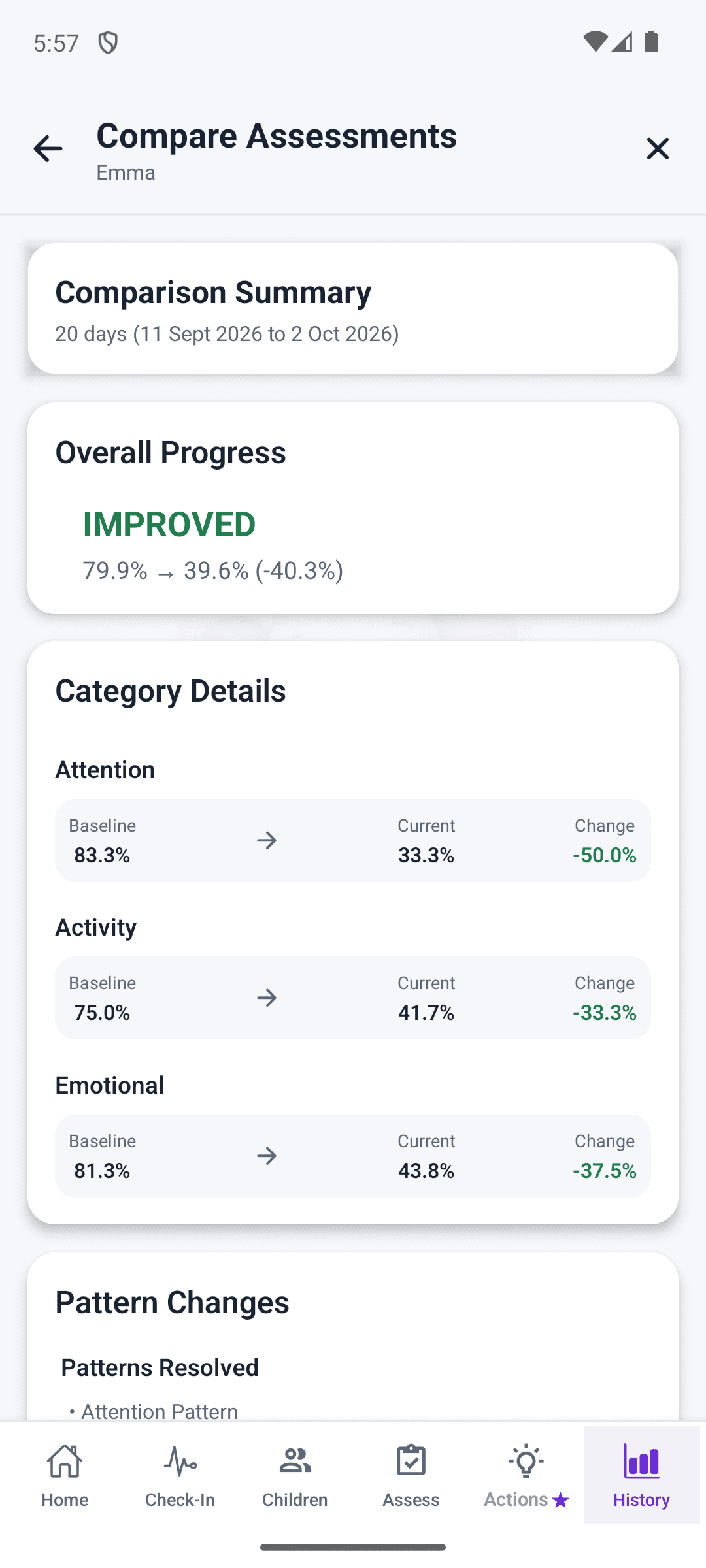
This is the job ParentPilot was built for. The daily check-in takes about thirty seconds, assessments can be compared over time, and the whole history exports as a PDF you can hand to a clinician. It does not diagnose anything and it is not a substitute for the appointment. It just means you arrive with a record instead of a recollection.
Three things worth avoiding
Do not lead with a diagnosis
You have almost certainly read a great deal before this appointment, and there is nothing wrong with saying that ADHD is what prompted you to come. Say it after the specifics rather than instead of them. Opening with a conclusion can narrow the conversation, and there are several things that look like ADHD from the outside, including sleep disorders, anxiety, hearing loss and specific learning difficulties. You want those genuinely considered rather than skipped past.
Do not coach your child beforehand
Children work out very quickly that this appointment matters, and many will hold it together for an hour in a way they cannot sustain at home or in a classroom of thirty. Expect that rather than fighting it. It is exactly why the clinician wants your records and the school's observations and does not rely on what happens in the room.
Do not bring only the worst days
The good days are information too. When things go well, what was different? Shorter tasks, more movement, a quieter room, more sleep, one instruction at a time instead of three. That pattern is often the most practically useful thing you take away from the whole process, whatever the assessment concludes.
What to ask before you leave the room
- What is the next step, and who arranges it?
- Does anyone else need to contribute, such as the school?
- What should I be watching for or recording between now and then?
- What else could explain what I am describing?
- What would change your view?
That last question is the useful one. The answer tells you exactly what evidence to gather next, which turns a vague wait into something you can act on. Write the answers down before you get to the car park, because they will be gone by dinner.
Frequently asked questions
How far in advance should I start preparing?
Three to four weeks of daily notes gives you something genuinely useful, and there is no downside to starting earlier. If you are on a waiting list of several months, begin now. The wait is the most valuable preparation window you will get, and it is the one thing about waiting that you can control.
What if the school will not put anything in writing?
Ask for something specific rather than a general statement. A short email answering two or three direct questions, such as how often your child needs instructions repeated or how long they stay on task independently, is usually easier for a teacher to write than an open ended report. Keep any existing emails, and bring the school reports you already have.
Should my child come to the appointment?
That depends on the clinician and your child's age, so ask when you book. Some assessments involve talking with the child directly and some do not. It is also worth asking whether there is anything you should tell your child in advance, because arriving at an unexplained appointment about their own behaviour is unsettling for most children.
Does bringing more information make the assessment faster?
It does not necessarily shorten the process, because assessments usually run across more than one session regardless. What it changes is where the first appointment starts from. Arriving with school reports and a few weeks of records means the clinician is working on your actual situation rather than spending the visit collecting basic background.
What if we get told it is nothing to worry about?
Ask two questions before you leave. Ask what else explains what you have described, and ask what would need to change for a referral to be appropriate. That turns a closed answer into something specific you can work towards, and it gives the concern somewhere to go rather than requiring you to start from the beginning later.