Most parents start tracking after an appointment where they could not answer a question. How often does it happen? Is it worse at school or at home? Has it changed since last year? Every one of those is a reasonable question and almost nobody can answer them from memory, because that is not how memory works.
The good news is that useful tracking is far lighter than people expect. It is not a research project and it does not need a spreadsheet with fifteen columns. The version that works is the version you will still be doing in a month.
Why daily notes beat a weekly summary
A short note every day beats a detailed note once a week, every time. Daily entries capture ordinary days, and ordinary days are what tell you what normal actually looks like for your child. Weekly summaries drift towards whatever was memorable, and what is memorable is almost always what was difficult. A month of weekly summaries will tell you that everything is terrible, which is neither accurate nor useful to a clinician.
There is a second reason. You are looking for patterns, and patterns only appear when you have enough data points close enough together. Four weekly entries cannot show you that the hard days cluster on Mondays, or follow late nights, or happen on the days there is a substitute teacher. Twenty eight daily entries can.
What to record each day
Keep it to five things or fewer. If it takes longer than a minute you will skip it on exactly the evenings that matter most, when everybody is tired and the day has gone badly.
- Focus. A one to five rating. You are not measuring anything precisely. You are creating a number that is comparable to yesterday's number.
- How challenging the day was overall. Again one to five. Keeping this separate from focus matters, because a day can be high in difficulty and fine for concentration, and that distinction turns out to be informative.
- Mood, and the shape of it. A day that started well and fell apart after school is a different day from one that was hard throughout. Note which it was.
- What you tried. Any strategy, routine change or approach you used, and whether it seemed to help. Over time this becomes the most practically useful column in the whole record.
- One thing that went well. This matters more than it sounds. It keeps the record honest, it gives you something to point at on the bad weeks, and it is the single biggest reason people keep going past the first fortnight.
- 1FocusOne to five
- 2How challenging the day wasOne to five, kept separate from focus
- 3Mood, and the shape of itFell apart after school, or hard throughout
- 4What you triedAnd whether it seemed to help
- 5One thing that went wellThe reason people keep going
Add the setting whenever something notable happens. Home, school, the shops, a friend's house, the car. Whether a behaviour shows up everywhere or in one place only is one of the first things anyone assessing your child will ask about, and it is very hard to reconstruct after the fact.
Write what you could have filmed
This is the discipline that makes a record worth reading months later. Describe behaviour, not character.
"Left the table four times during dinner" is a record. "Was difficult at dinner" is a verdict, and in three months it will tell you nothing at all, because you will not remember what difficult meant that night. Worse, a record full of judgements is uncomfortable to reread and gets abandoned for that reason alone.
It is harder than it sounds at the end of a bad evening, and it is worth the effort anyway. Behavioural descriptions stay useful indefinitely. Judgements do not.
How to actually keep it going
- Attach it to something you already do every day. After the children are in bed, or while the kettle boils. A habit with no anchor lasts about nine days.
- Keep the entry short enough that a bad day does not stop you. If your form has fifteen fields you will skip it precisely when the data would have been most interesting.
- Record on the good days too. This is the one people get wrong. A record of only the bad days makes every pattern invisible, because there is nothing to compare against.
- Do not go back and fill in a week at once. It will be inaccurate in the specific direction that makes things look worse than they were.
- Keep going after things improve. The improvement is the finding. If you stop recording when it gets easier, you lose the evidence of what changed and when, which is exactly what a clinician will want to know.
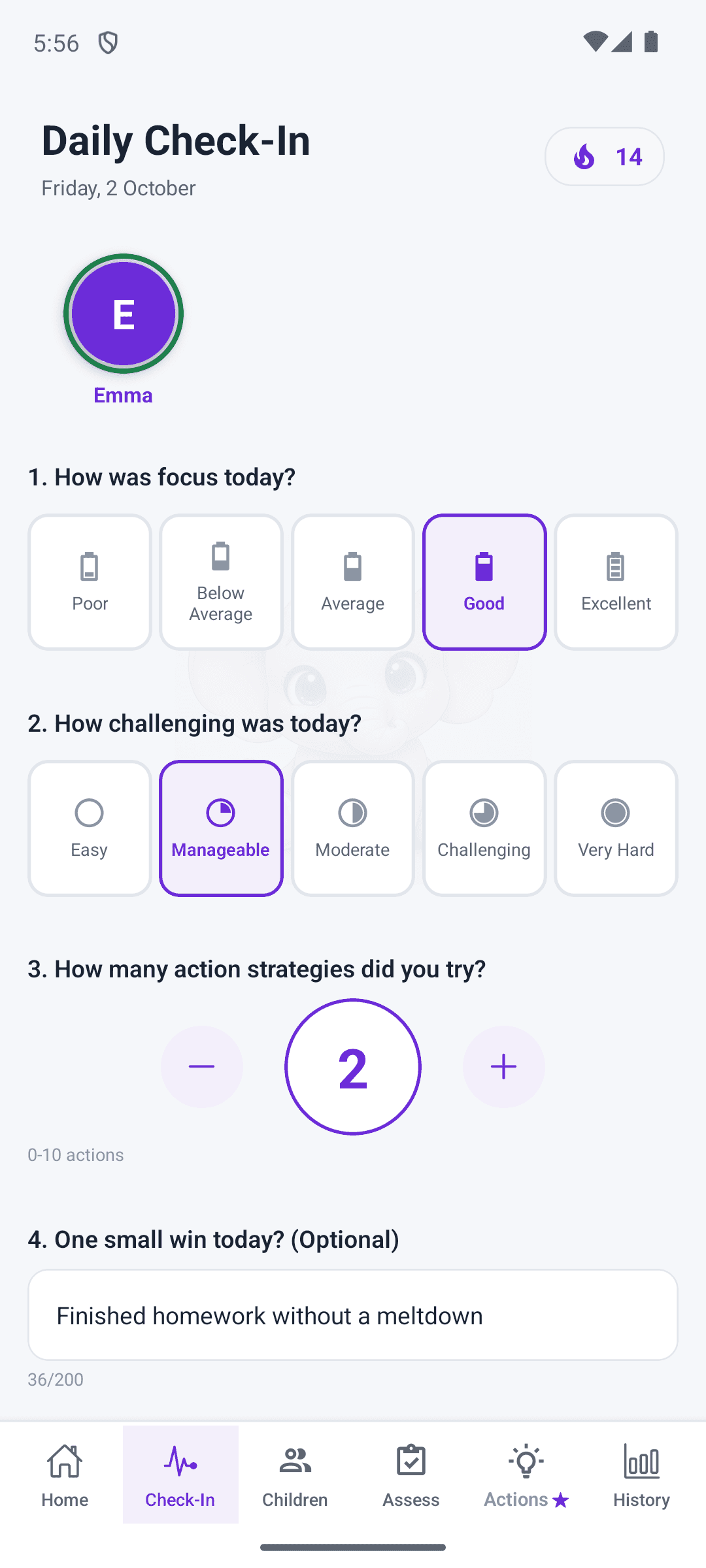
ParentPilot is built around this. The daily check-in covers focus, how challenging the day was, how many strategies you tried and one small win, and takes about thirty seconds. It is a tracking tool for parents. It does not diagnose ADHD, and no amount of home data can. Only a qualified health professional can make that call.
What to look for once you have a few weeks
Read the entries as a set rather than one at a time. What you are looking for is usually mundane, and that is what makes it useful, because mundane patterns are the ones you can act on.
- Time of day. A great many families find late afternoon is consistently the hardest hour of the day. If that is true in your house, it is partly a scheduling problem, and scheduling problems have solutions.
- Transitions. Between activities, in and out of the house, on and off screens, into and out of the car. Difficulty very often clusters at the joins rather than during the activities themselves.
- Sleep the night before. Look at the entries for the day after a late night and see whether they are different. This one shows up quickly.
- Hunger. The gap between school pickup and dinner does a lot of damage in a lot of households, and it is one of the easiest things to test a change against.
- The good days. Go back to the days you rated highest and work out what was different. Fewer activities, more time outside, one instruction at a time, a weekend rather than a school day. This is where the practically useful findings are.
How long before it is useful
Three to four weeks is usually enough to see a shape, and it is roughly the point at which the record becomes worth showing to somebody. A single week can be badly misleading, because a single week can contain a cold, a birthday party, a school camp and a growth spurt.
If you are waiting for an appointment, that waiting time is the most valuable tracking window you will get. Read what to bring to your child's ADHD assessment for what to do with the record once you have it.
Frequently asked questions
Should I tell my child I am tracking them?
For most families, yes, framed honestly and without drama. Something like keeping notes so the doctor understands how things are going is usually enough. Children often find it reassuring that somebody is taking the difficulty seriously. A record kept secretly tends to feel like surveillance if it is discovered, and older children in particular will react badly to that.
What if my partner and I see completely different things?
That is worth recording rather than resolving. Genuine differences between settings and between adults are information, and clinicians expect them. Often it reflects different times of day, different demands, or different routines rather than anybody being wrong. Note who observed what and leave it there.
Do I need to track every single day?
No, and expecting to is one of the reasons people quit. Missing days is normal. A record with gaps is still far better than no record, and far better than one week of very detailed notes followed by nothing. Aim for most days and do not treat a missed day as a failure worth abandoning the whole thing over.
Will a clinician actually look at this?
They will use it, though probably not by reading every entry. What they want from a home record is frequency, consistency across settings, and how long the pattern has been present. A summary you can hand over, or a few clear examples with dates and counts, is more useful in a short appointment than a large pile of raw notes.
Is tracking still worth it if we already have a diagnosis?
Yes, and arguably more so. After a diagnosis the questions change to whether a strategy is working, whether a change at school has helped, and what to report at the next review. All of those are much easier to answer with a record than from memory, particularly at a review appointment months later.